Location, Location, Vibration: The Unwritten Rules of Claiming Your Patch on a UK Dancefloor
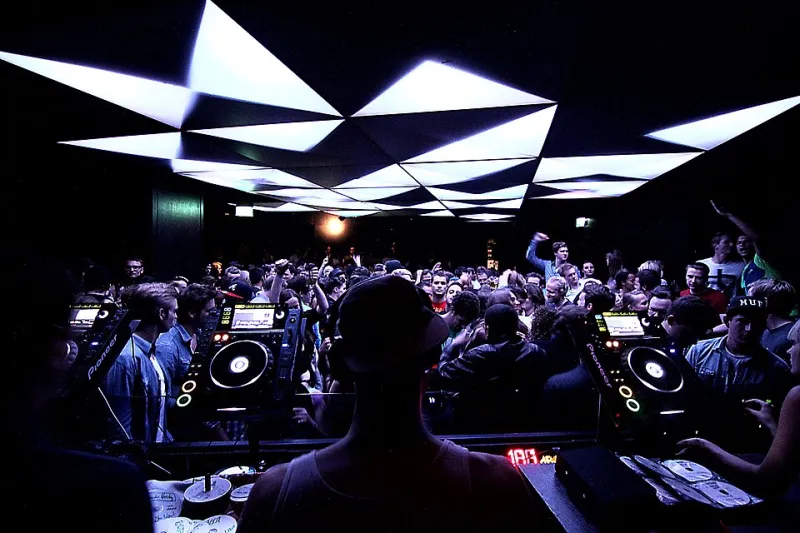
Photo: Arnold Jaeger Werner, CC BY 2.0, via Wikimedia Commons
You’re through the door, coat checked, first pint in hand, and the room is already a solid mass of shoulders and bass. Somewhere in there is the spot that will make your night — and you’ve got about ninety seconds to find it before the crowd sets like custard. Welcome to the dancefloor property market, where nothing is for sale, everything is negotiable and the currency is elbow room.
The Lay of the Land: Four Plots and What They Cost You
Walk into any big UK club in 2026 and you’ll see the same four micro-neighbourhoods.
The speaker-side squat is the freehold with the highest price. You’re close enough to feel the kick drum in your sternum, the rig is doing the work and the crowd around you is generally there for the music. The cost? Your ears will ring until Tuesday and you’ll be shouting your drink order like a man hailing a ferry.
The pillar lean is the terraced house of the dancefloor: unglamorous, structurally sound, surprisingly sought-after. A pillar gives you something to lean on, a natural boundary and a decent sightline. It also makes you a human roundabout, so expect to be nudged by every person cutting across the room.
Bar-adjacent is the convenience flat. Great for drink runs, terrible for dancing. You’ll spend the night in a queue-shaped limbo, holding two pints and a coat while someone else’s mate “just squeezes past”.
The back wall is the commuter belt: more space, less atmosphere. Good if you want to dance without being elbowed, bad if you want to feel like you’re part of the thing. The back wall is where groups go to have a chat and accidentally become a soft-play area for people trying to get to the bogs.
Squatters’ Rights: Claiming Without Causing a Scene
The first rule of a good spot is that you don’t claim it with a bag. A bag on the floor is not a reservation; it’s a trip hazard with delusions of grandeur. Claim with your body, plant your feet and start dancing. A moving body holds space better than a static one, and it signals to everyone else that you’re not just passing through.
Arrive early if you care. The best real estate goes in the first hour, before the crowd thickens and the room’s geography hardens. The second rule is the two-foot rule: your spot is roughly the width of your shoulders plus a pint. If you’re spreading out like a starfish to save room for five mates who are “five minutes away”, you’re not a resident, you’re a land grab.
And if you do need to hold a space for someone, do it openly. A quick “sorry, my mate’s just coming back” works. A silent blockade and a dirty look does not. The dancefloor has a long memory and a short fuse.
The Friend-Shaped Placeholder: Britain’s Most Abused Planning Permission
We’ve all met the friend-shaped placeholder: the one person standing in a circle of six empty metres, insisting that the rest of the group is “just at the bar”. They’ve been at the bar for forty minutes. They are not coming back. They are in a different postcode, possibly a different club.
The unwritten rule is simple: one person, one spot. If your mate isn’t back in fifteen minutes, the lease expires and the space goes to market. That’s not harsh; that’s planning policy. The alternative is a dancefloor made of anxious little islands of saved space, and nobody wants to rave in a car park.
The 2am Turf War: When to Hold and When to Fold
Peak time changes the physics of a room. The crowd stops being a collection of individuals and becomes a slow-moving liquid, and your spot is suddenly on a fault line. You’ll feel it before you see it: the repeated shoulder bump that isn’t apologised for, the group that keeps drifting into your orbit, the person dancing with their elbows at shoulder height like they’re doing semaphore.
Hold your ground if you’re in a good spot and the pressure is just the usual ebb and flow. A smile and a slight shift of weight usually buys you another twenty minutes. But know when to fold. If you’re spending more energy defending your patch than dancing on it, you’ve already lost. The strategic surrender — moving two metres to the left with your dignity intact — is a valid move. The dancefloor is not a siege.
Trading Up: The Mid-Set Migration
The best spot at 11pm is rarely the best spot at 1am. People leave, groups migrate, the bar queue peaks and troughs. The art is the mid-set migration: a quick recon lap, a mental note of where the space is opening up, then a coordinated move with your people. Never leave a spot without a destination. The “false exit” — wandering off, then doubling back — fools nobody and annoys everybody.
If you’re upgrading, do it between tracks, not during a drop. Nobody wants to be the person who blocks the view during the one tune everyone came for.
What the Door Staff and Promoters Actually See
Ask anyone who works a big room and they’ll tell you the same thing: the best spot is often the one nobody wants at 11pm. A promoter in Leeds puts it bluntly: “The corner by the fire exit looks like a punishment until the room fills up. Then it’s the only place you can actually dance.”
Door staff have their own list. Don’t sit on the bass bins, don’t camp on the stairs, don’t block the fire exits and don’t argue with a steward who asks you to move. They’re not judging your moves; they’re keeping the room legal and upright. A good spot is one that doesn’t make you a problem for everyone else.
The Only Rule That Matters
The dancefloor is a commons, not a freehold. Claim your patch, hold it kindly, trade it fairly and move on when the crowd says so. Do that and you’ll always find a spot — even if it’s not the one you first wanted. And in a packed 2026 club, that’s the real property ladder.